Consultants
Websites for consultants that turn enquiries away
Your scarcest asset is your own time, and most of it goes on conversations that were never going to become work. A consultant's website has one job the others don't — to disqualify, early and politely, so the calls you do take are worth having.
Get my build plan →
The problem
Most consultants' sites are a CV with better typography
Career history, a list of skills, logos of past clients, and a contact form. It reads as somebody available for work rather than a practice offering something specific — and it attracts exactly the enquiries you'd want to turn down.
- No indication of what an engagement costs or how long it runs. Every enquiry starts from zero, and a third of them end the moment a number is mentioned — after you've spent an hour.
- A skills list rather than an offer. "Strategy, transformation, change management" describes a person. It doesn't tell a buyer what they'd be buying.
- Client logos with no story. A wall of marks proves you were in the building. It doesn't say what you did or what changed.
- A CV in structure and tone. Chronological history, first person, availability. It positions you as a candidate rather than a supplier, which is a weaker place to negotiate from.
- Engagement shapes with indicative ranges. A two-week diagnostic, a three-month programme. Not a rate card — enough that someone can tell whether they're in the right place.
- Defined offers rather than capabilities. What the piece of work is, what comes out of it, and roughly how long. Buyers buy outcomes, not adjectives.
- Two or three engagements described properly — the situation, what you did, what changed. One of those beats twelve logos.
- A practice, presented as a business. Company identity, professional indemnity, how you contract. It reads as an established supplier because it is one.
How it plays out
A Thursday, late afternoon
Two enquiries. One qualifies itself out before it costs you anything.
What your enquiry form captures
The form is the filter
Every field is here to establish whether this is worth a conversation. The budget band is the one consultants resist and the one that changes the most.
The pages
What a consultant's site actually needs
Seven pages. Fewer than most sectors, because a consultant's site should be short and certain.
Connects to
What consultants usually wire in
Chosen for this work, not a list of everything we can connect.
Pricing
Published, so you don't have to ask
Studio
A strong, well-built site without bespoke design work.
then £69 per month
- Up to 8 pages
- Enquiry form designed around your business
- Google Business Profile setup
- One revision round
Signature
Where the website is a working part of how the job comes in.
then £89 per month
- Up to 12 pages, including area pages
- The integrations above, wired and tested
- Automated acknowledgement on every enquiry
- Migration with search positions kept
Three standard integrations are included. See what counts as one.
Enquire →Questions
What consultants ask us
Should I really put figures on the site?
Ranges, not a rate card. The objection is always that it invites negotiation, and in practice it does the opposite — it removes the enquiries that were never going to reach your number, before they cost you an hour. A range is also what lets a serious buyer decide to proceed without asking, and buyers who have to ask are more likely to compare you on price when they do.
Does a website help with my IR35 position?
No, and be careful of anyone who tells you it does. A website doesn't affect a status determination. What's true is narrower: being in business on your own account is judged on the whole picture, and how you present to the market is one part of that picture. A site that reads as a practice with defined offers, its own clients and its own commercial terms is consistent with that. It isn't evidence, it isn't a defence, and the determination is yours and your accountant's.
The rules changed in April. Does that affect me?
Possibly. From 6 April 2026 the thresholds for a "small" company rose — turnover under £15m, balance sheet under £7.5m, or fewer than 50 staff. Small clients are outside the 2021 off-payroll rules, so on those engagements the determination sits with you rather than them. More clients now qualify than did last year. That's a conversation for your accountant, not for us — we mention it because a lot of consultants haven't noticed.
I've only got two case studies. Is that enough?
Two described properly beat twelve logos. A buyer wants to see that you understood a situation like theirs and what changed — one page of that does more than a wall of marks proving you were in the building.
Do I need a blog?
Not a blog. A place to put something worth reading, four times a year, that a prospect can find when they search the problem rather than your name. An abandoned blog with three posts from 2023 is worse than no writing at all.
How long does it take?
Three phases — Discovery, Build, Launch. Deciding your engagement shapes and what to publish about price is usually the slow part, and it's the part worth taking time over. We agree the timeline at Discovery.
Do I own it?
Yes. The domain is registered in your name or your company's, not ours, and transfers free on request. If you leave, the site leaves with you.
Also from the studio
Keep looking
Get a build plan for your practice
Five questions and we'll send the pages, what the enquiry form should capture, and a fixed price. No obligation and no call unless you want one.
Get my build plan →Sample site
Wireframe from Discovery, then the finished build
The wireframe is agreed before anything is designed. Press the button to see what it became.Operations and capacity consulting for manufacturers
Wireframe agreed at Discovery
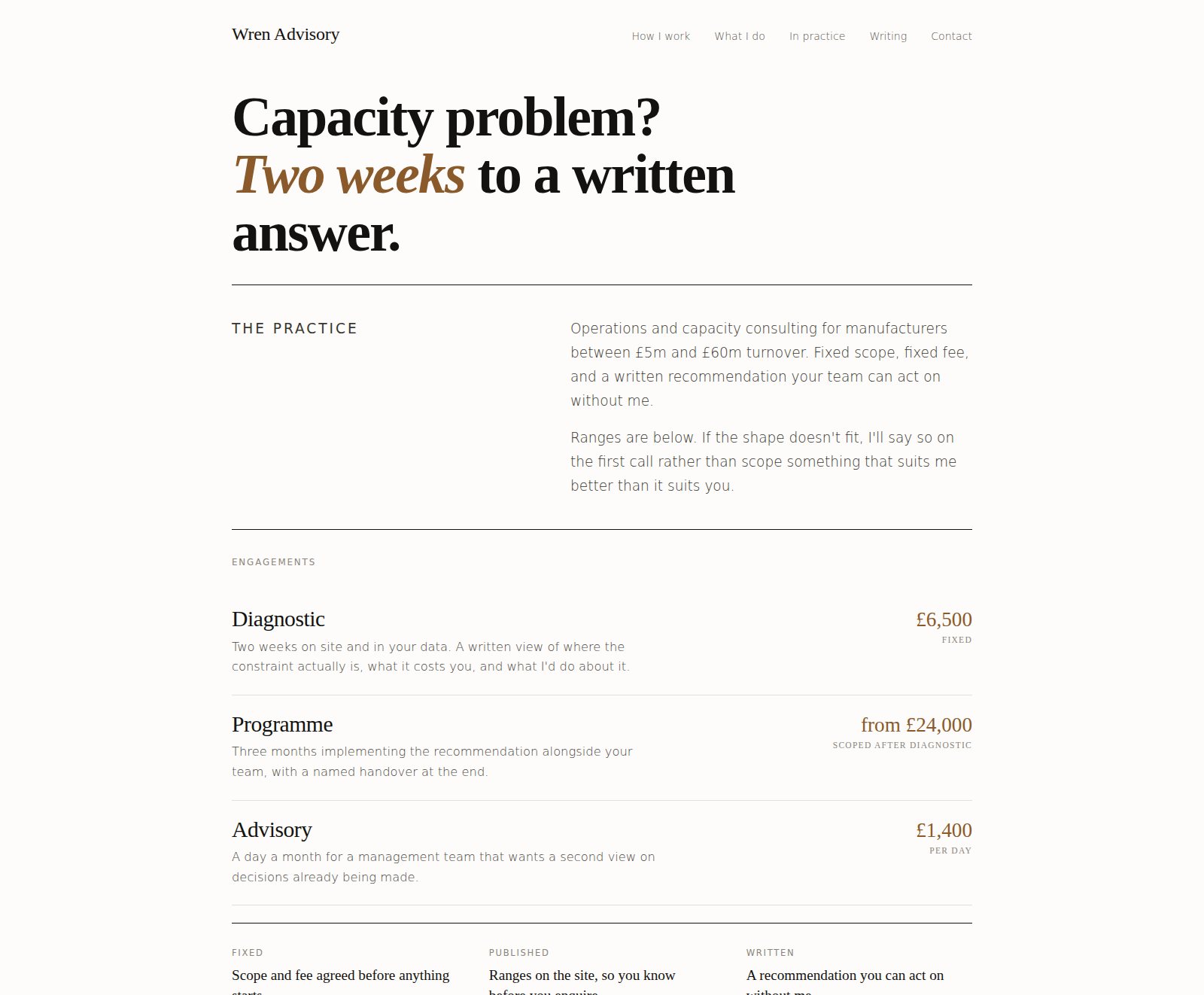
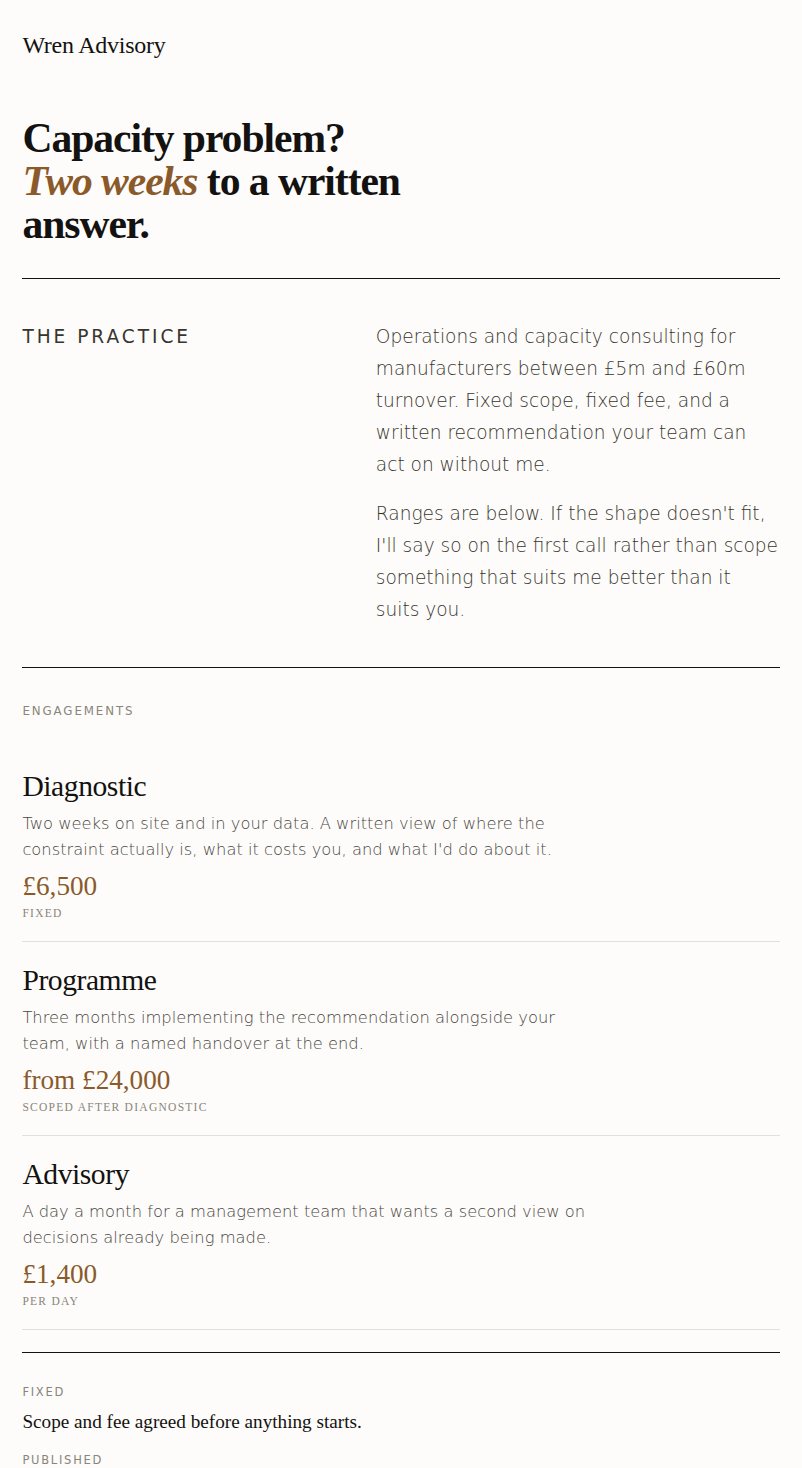
Every build starts from a wireframe you have already agreed. Nothing is designed before that.
Get my build plan →