Recruitment
Websites for agencies that work as hard on hirers as on candidates
Most recruitment sites are built for candidates — job board, apply button, upload a CV. Hirers are the ones who pay you, and they usually get a contact form and a paragraph about your values. Yours will give them a reason to ring, and tell them what kind of business you are.
Get my build plan →
The problem
Your site is built for candidates. Hirers are the ones who pay you.
A hiring manager with a vacancy and three agencies to choose between is not going to browse your jobs. They want to know what you recruit, whether you've placed this role before, how you charge, and what happens if it doesn't work out. Most agency sites answer none of that.
- The whole site is the job board. A hirer lands on a page designed for someone looking for work, and has to hunt for the part that's for them.
- "We are a leading recruitment agency" and no statement of whether you're an employment agency, an employment business, or both. Those are different things with different obligations, and a hirer who knows the difference notices.
- No terms of business anywhere. Rebate period, transfer fees, notice — the questions that decide whether they use you. Asking means an awkward call before they've committed to anything.
- One form for everyone. A candidate uploading a CV and a hiring manager with a live vacancy land in the same inbox, in the same format, at the same priority.
- Two front doors. Hirers and candidates get their own route from the first click, with different pages and different forms.
- A plain statement of what you are. Employment agency, employment business, or both — and which sectors. It reads as competence, not compliance.
- Your commercial terms in outline, published. Rebate structure, how you charge, what happens on a withdrawal. It's the fastest way to disqualify the enquiries you don't want.
- A vacancy enquiry that arrives usable — role, salary band, location, whether it's perm or temp, and when they need someone.
How it plays out
A Monday, mid-morning
A vacancy and a candidate, minutes apart, going to different places.
What your enquiry form captures
Two audiences, two forms
The hirer's form is the one that earns money, so it asks the questions a consultant would otherwise spend a call establishing.
The pages
What an agency's site actually needs
Nine pages, and they split into two halves that barely overlap.
Connects to
What agencies usually wire in
Chosen for this work, not a list of everything we can connect.
Pricing
Published, so you don't have to ask
Studio
A strong, well-built site without bespoke design work.
then £69 per month
- Up to 8 pages
- Enquiry form designed around your business
- Google Business Profile setup
- One revision round
Signature
Where the website is a working part of how the job comes in.
then £89 per month
- Up to 12 pages, including area pages
- The integrations above, wired and tested
- Automated acknowledgement on every enquiry
- Migration with search positions kept
Three standard integrations are included. See what counts as one.
Enquire →Questions
What agencies ask us
Why does it matter whether we say we're an agency or an employment business?
Because they're different things in law and different obligations attach. An employment agency finds permanent work; an employment business supplies temporary workers. Most firms do both, and there's nothing wrong with that — but a hirer who knows the difference reads a site that doesn't say as one that hasn't thought about it. We'll build the page; what it says about your obligations is yours and your advisers'.
Our site mentions the EAS. Is that still right?
Not since April 2026. The Fair Work Agency brought together several enforcement bodies including the Employment Agency Standards Inspectorate, and is now the state regulator for agencies in England, Scotland and Wales. It's a small thing to update, and it's the kind of detail a compliance-minded hirer notices.
Should we really publish our terms?
Not the full contract — the outline. Rebate period, fee basis, notice. Firms resist this because they think it invites negotiation, and it does the opposite: it disqualifies the enquiries that were never going to pay your rate, before they cost you a briefing call. The agencies that publish tend to get fewer enquiries and better ones.
Can it pull vacancies from our ATS?
Usually. Most systems offer a feed or an API, and each role gets its own page with the structured markup Google for Jobs reads. Tell us which system at Discovery and we'll say honestly whether it's straightforward or a bespoke job.
What about candidate data?
CVs are personal data and a lot of agency sites collect them with no retention notice and no deletion route. We build the notice and the route. What your retention period should be is a decision for you — we'll put whatever you decide where a candidate can find it.
How long does it take?
Three phases — Discovery, Build, Launch. The ATS connection is usually the variable; everything else is predictable. We agree the timeline at Discovery and you'll know immediately if anything slips.
Do we own it?
Yes. The domain is registered in your company's name, not ours, and transfers free on request. If you leave, the site leaves with you.
Also from the studio
Keep looking
Get a build plan for your agency
Five questions and we'll send the pages, what the enquiry form should capture, and a fixed price. No obligation and no call unless you want one.
Get my build plan →Sample site
Wireframe from Discovery, then the finished build
The wireframe is agreed before anything is designed. Press the button to see what it became.Industrial and logistics recruitment
Wireframe agreed at Discovery
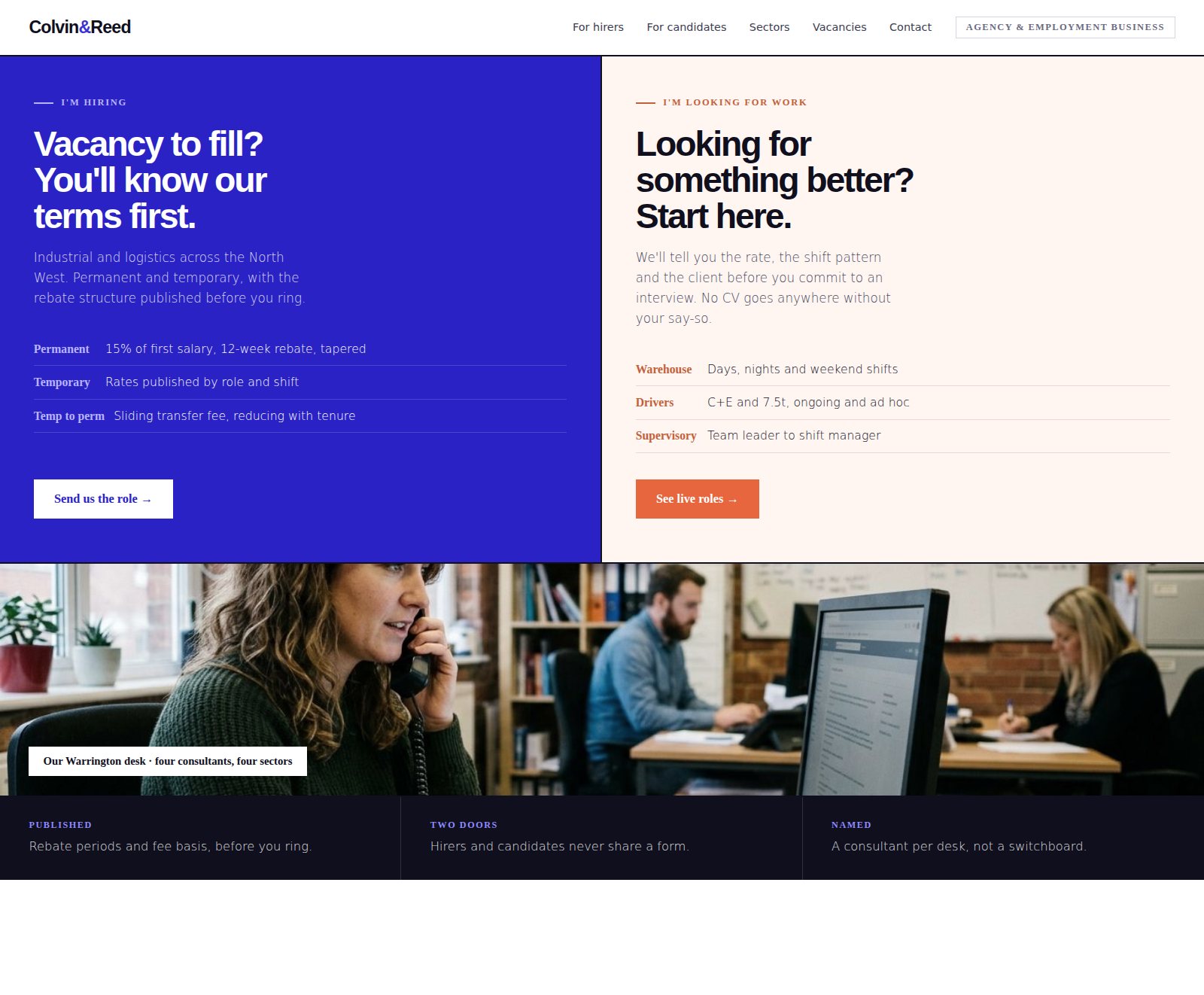
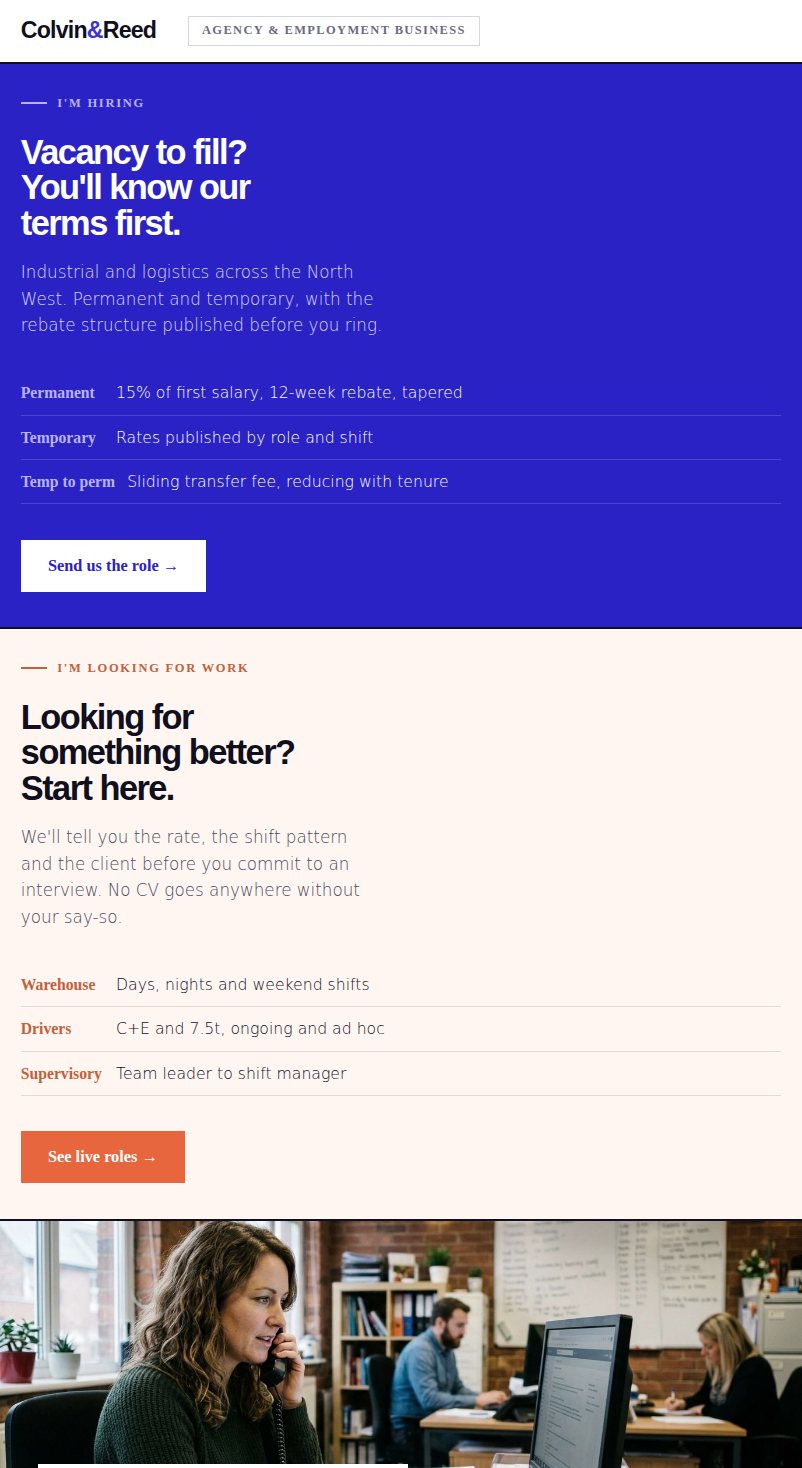
Every build starts from a wireframe you have already agreed. Nothing is designed before that.
Get my build plan →