Family, wills & probate
Websites for solicitors, built around the rules you're judged on
Most firms' websites are treated as marketing. Yours is also the document the SRA looks at when it runs a web sweep. We build the structure that makes the transparency rules straightforward to keep — and an enquiry form that tells you what the matter is before you pick up the phone.
Get my build plan →
The problem
Your website is the bit the regulator can see without asking
A firm's file management and client care can be immaculate and none of it is visible from outside. The website is. It's the only part of the practice the SRA can inspect without a visit, and it's usually the part nobody owns.
- Probate is listed with no prices next to it. Publicising the service is what triggers the duty — the SRA's own guidance is explicit. Between May 2023 and August 2024 its web sweeps produced 439 warning letters and 36 fixed penalties.
- The SRA number and complaints route are in the footer, in six-point grey, because nobody could think where else to put them.
- A price was published in 2019 and never revisited. A quote that materially diverges from the published range, without explanation, is a reportable issue.
- Enquiries arrive as "please call me" and nothing else — no matter type, no timescale, no idea whether it's a straightforward will or a contested estate.
- The price information has its own page, prominent and signposted the way the rules require, structured so a fee earner can update a figure without a developer.
- Regulatory information sits where the rules put it, not where it fits the design.
- A review date on the price page, so a figure set in 2026 doesn't quietly become a 2029 problem.
- The enquiry tells you the matter type, the stage and the timescale, so you know whether it's a fixed fee, an hourly matter, or one to decline before anyone's time is spent.
How it plays out
A Thursday morning
One enquiry, and everything you'd otherwise establish on a twenty-minute call.
What your enquiry form captures
Every field earns its place
Not a generic contact form. Each field is here because it changes what happens next — and two of them exist because of the conflict check.
The pages
What a firm's site actually needs
Eight pages. Two of them exist because of the rules, and they aren't optional.
Connects to
What firms usually wire in
Chosen for this work specifically, not a list of everything we can connect.
Pricing
Published, so you don't have to ask
Studio
A strong, well-built site without bespoke design work.
then £69 per month
- Up to 8 pages
- Enquiry form designed around your business
- Google Business Profile setup
- One revision round
Signature
Where the website is a working part of how the job comes in.
then £89 per month
- Up to 12 pages, including area pages
- The integrations above, wired and tested
- Automated acknowledgement on every enquiry
- Migration with search positions kept
Three standard integrations are included. See what counts as one.
Enquire →Questions
What firms ask us
Do you handle our transparency compliance?
No, and be wary of anyone who says they do. We build the structure — a price page that's prominent and signposted the way the rules require, the regulatory information where it belongs, and a way to update a figure without ringing a developer. What you publish is yours, and your COLP signs it off. We'll tell you where the SRA guidance says something goes; we won't tell you what it should say.
We only do family work. Do the price rules apply to us?
Family law isn't on the SRA's list of services requiring published prices. Probate is, if it's uncontested with UK assets — and the duty triggers on publicising that you offer it. So if the site mentions probate, the requirement follows. Worth checking against the current guidance rather than taking our word for it; the rules were last revised in April 2025.
Who writes the content?
We draft it, you review it. That isn't a courtesy — since October 2024 the SRA has required content produced with AI to be reviewed by a qualified person before publication, and firms have faced enforcement for skipping it. Nothing goes live on a law firm site we build without a solicitor at your firm having read it. It's in our terms.
How do we show up for our town?
That's what the practice-area pages and the areas-covered page are for. A firm doing family and probate is competing on two quite different searches, and one page trying to do both ranks for neither. We set up and verify the Google Business Profile, which is where the map results actually come from.
We have a case management system. Does it connect?
Usually. Most of the common systems accept an enquiry by webhook or email parse, and that's a Signature-tier integration. Tell us which one at Discovery and we'll tell you honestly whether it's straightforward or a bespoke job.
How long does it take?
Three phases — Discovery, Build, Launch. The build isn't the slow part; content review usually is, and on a law firm site that review is non-negotiable. We agree the timeline at Discovery and you'll know immediately if anything slips.
Do we own it?
Yes. The domain is registered in your firm's name, not ours, and transfers free on request. If you leave, the site leaves with you.
Also from the studio
Keep looking
Get a build plan for your firm
Five questions and we'll send the pages, what the enquiry form should capture, and a fixed price. No obligation and no call unless you want one.
Get my build plan →Sample site
Wireframe from Discovery, then the finished build
The wireframe is agreed before anything is designed. Press the button to see what it became.Straightforward advice on family, wills and probate
Wireframe agreed at Discovery
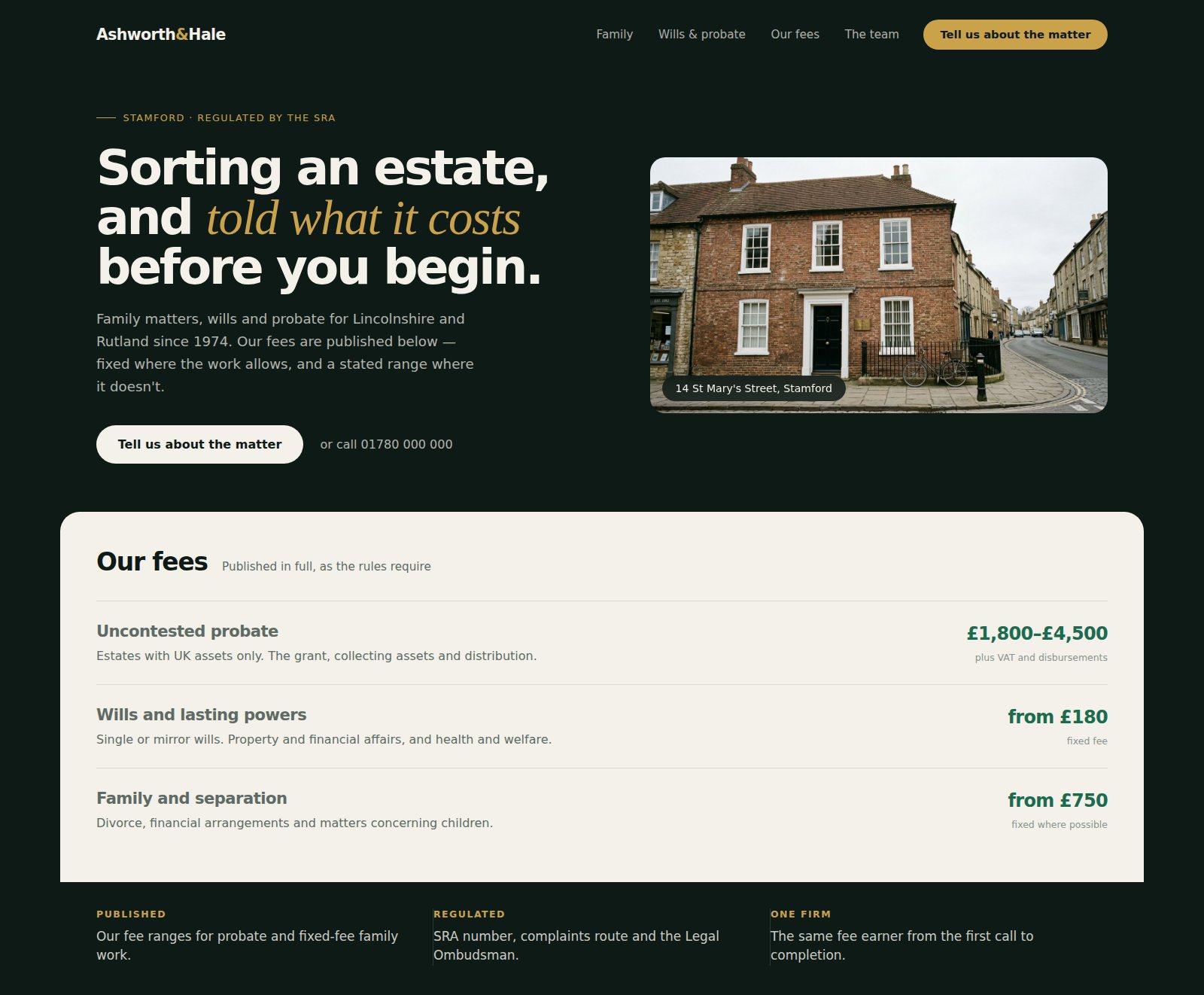
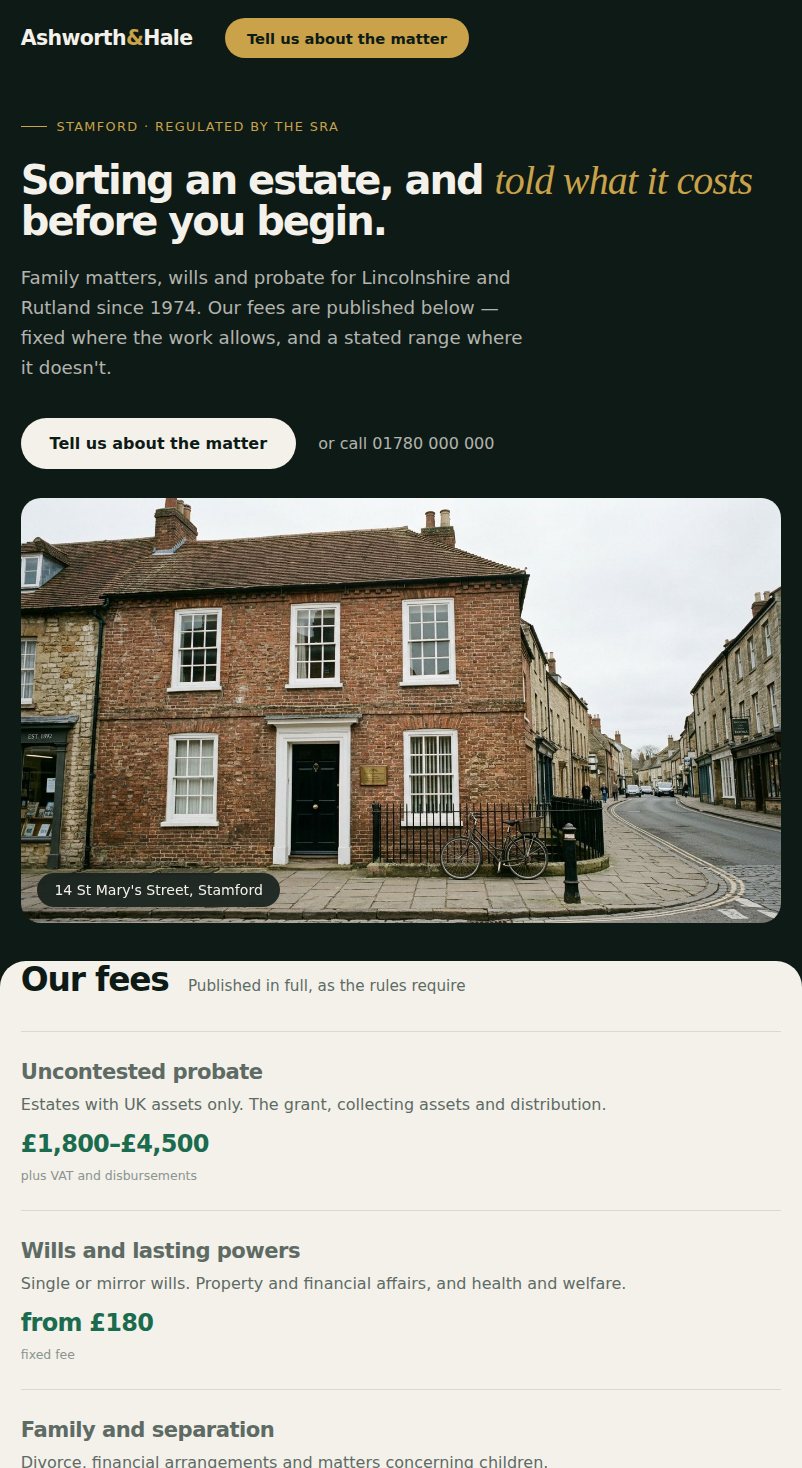
Every build starts from a wireframe you have already agreed. Nothing is designed before that.
Get my build plan →